





Mixed-Dog Team Dynamics: How Dogs Influence Each Other’s Pace & Energy
5 Jan 2026
When dogs train side by side, something subtle but powerful happens. Long before humans adjust their pace or check a watch, dogs are already negotiating speed, effort, and intent – through posture, breathing rhythm, and micro-signals that are easy to miss from the sidelines.
This is where Qpaws changes the game. What trainers once inferred through experience and intuition can now be observed, measured, and understood through real data. Multi-dog tracking, energy metrics, and recovery patterns reveal a simple truth:
Dogs don’t just run together. They adapt to each other – shaping pace, motivation and performance as a unit.
This article explores mixed-dog team dynamics: how dogs influence each other’s energy, how pairings can amplify or hinder performance, and how data-driven insights help owners train smarter.
The Power of the Pack: How Dogs Sync
Dogs are social athletes by nature. Whether hunting, pulling, or running trails, they evolved to move in groups, and that instinct still governs how they train today.
Natural Synchronization in Motion
When dogs exercise together, you’ll often see:
pace mirroring – one dog subconsciously matches the stride length and cadence of another,
emotional contagion – excitement, stress, or calm spreads rapidly through the group,
body-language alignment – head position, tail carriage, and even breathing rhythms begin to synchronize.
In sled teams, canicross pairs, or multi-dog trail runs, this synchronization is not accidental. It reduces friction, conserves energy, and improves group efficiency.
Owners often notice this intuitively – one dog “lifts” another on hard days, or a calmer companion steadies an over-eager runner. Qpaws data confirms these observations, showing converging speed curves and aligned rest-work cycles during shared sessions.
Breed Combinations and Energy Balances
Not all dog pairings behave the same. Breed tendencies, individual conditioning, and temperament all influence how energy flows within a team.
Complementary vs. Conflicting Dynamics
Some combinations naturally balance each other:
High-drive + steady breeds (e.g., Border Collie & Labrador) often result in a controlled but motivated pace.
Endurance breeds together (e.g., two Huskies) may push intensity higher – great for performance, risky without recovery monitoring.
Other pairings can create tension:
a very high-energy dog paired with a low-stamina or brachycephalic breed may force uneven pacing;
one dog consistently overreaching to keep up can lead to silent overexertion.
Practical Pairing Tips
Match average sustainable pace, not just enthusiasm.
Observe post-run recovery: who bounces back quickly, who doesn’t.
Rotate pairings during the week to avoid chronic overload on one dog.
Internal Qpaws insights on how much exercise dogs really need and why consistent daily movement beats sporadic intensity are particularly useful when designing mixed-breed routines.
Hierarchy and Leadership on the Run
Every multi-dog activity has structure, even if it’s invisible.
Who Leads, Who Adapts
Leadership during movement is fluid but real. One dog often:
sets the initial pace,
chooses line and positioning,
signals transitions between effort and recovery.
Other dogs adapt by adjusting stride, spacing, or effort. Importantly, leadership does not always equal dominance in daily life – it is often context-specific and activity-driven.
Subtle signals that shape performance
Positioning: dogs running slightly ahead tend to dictate tempo.
Eye contact and head turns: micro-checks that confirm cohesion.
Consistency: dogs that maintain stable pacing often become de facto leaders.
Tracking tools make these roles visible. Over time, Qpaws data highlights which dog consistently initiates accelerations or stabilizes group speed – valuable input for training plans and injury prevention.
Real-Time Insights with Qpaws Tracking
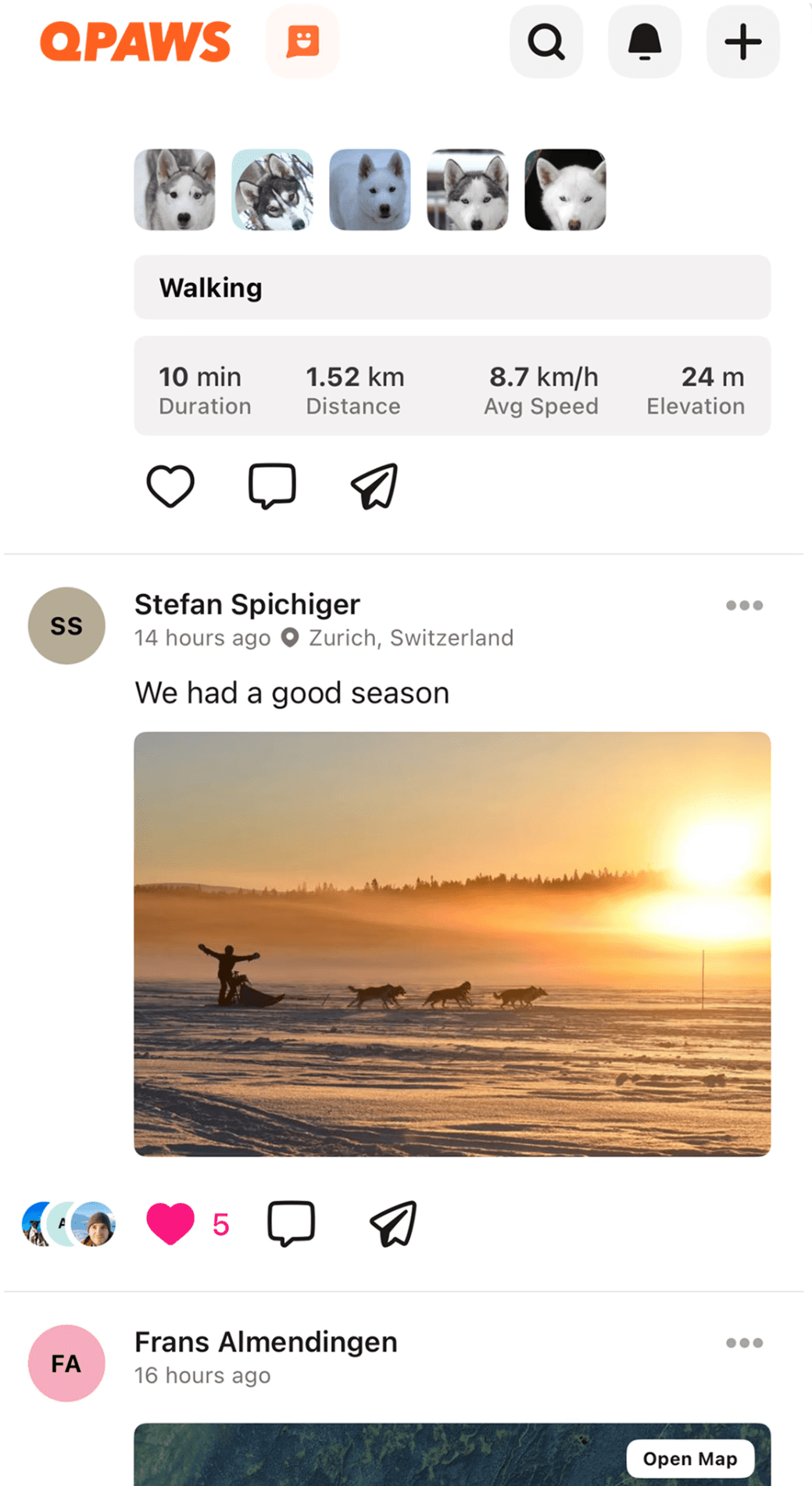
Technology turns observation into understanding. With multi-dog tracking, now you can compare:
speed curves between dogs during the same session,
energy expenditure differences under identical conditions,
recovery timelines after shared efforts.
Patterns emerge quickly. One dog may consistently spike early and fade, while another warms up slowly but sustains effort. When trained together, these tendencies influence each other—for better or worse.
What Owners Actually Learn
Which pairings improve efficiency versus increase strain.
When one dog is compensating for another.
How team composition affects post-exercise recovery.
These insights connect directly with broader Qpaws resources on dog endurance training, recovery after exercise, and early signs of overexercising – turning raw data into practical decisions.
Community Wisdom: Learning from Other Teams
Data becomes more powerful when shared.
Collective learning inside the Qpaws community
Mixed-dog teams across disciplines (mushing, canicross, hiking, working dogs) share activities, compare results, and discuss unexpected outcomes:
dogs that thrive together despite “mismatched” breeds,
pairings that looked perfect on paper but failed in practice,
adjustments that transformed harmony and reduced injuries.
Seeing how other owners solve similar challenges accelerates learning far beyond trial and error.
By exploring shared runs and discussions, users gain context: your dogs’ dynamics are unique, but patterns repeat across teams.
Training Smarter Together
Successful mixed-dog training is not about forcing uniformity, but it’s about harmony.
Practical Takeaways
Watch behaviour and data because neither alone tells the full story,
adjust pairings based on recovery, not just performance,
treat leadership as a variable, not a fixed role,
prioritise well-being over competition, especially in mixed-energy teams.
When dogs move well together, training becomes more than exercise – it becomes shared purpose. With the right observation, community insight, and data-driven tools, owners can support that harmony while protecting long-term health.
Dogs influence each other every step of the way. The better we understand that relationship, the better we train together. 🐾