





The canicross community has a persistent myth: you need trails to train for trails.
You don't.
Some of the most well-conditioned canicross dogs in Europe are city dogs. They train on pavements, in parks, up stairwells, and along canal paths. Their handlers have learned to extract more useful training stimulus from a 5 km city loop than a casual trail runner gets from a 15 km forest session.
Urban training isn't a compromise. Done correctly, it's a systematic way to build the fitness, focus, and technical skill that wins races. The constraints of city life – traffic, surfaces, crowds, limited space – stop being obstacles the moment you start using them deliberately.
This guide is for competitive canicross athletes, active dog owners, and anyone who has ever looked at concrete pavement and thought, "This isn't the right place to train". It is. Here's how.
Why Urban Environments Can Be Better Than You Think
Before getting into tactics, it's worth reframing what training actually is – and clarifying what structured training adaptation actually looks like.
Training is a stimulus that forces adaptation. Any environment that delivers the right stimulus – cardiovascular load, neuromuscular challenge, mental engagement – adapts. Trails do this well. So does a well-planned urban session.
In some ways, city environments offer advantages that trails don't:
Higher distraction density. A dog that learns to maintain drive, pace, and line manners past pigeons, cyclists, toddlers, and other dogs is a dog with genuinely superior focus. Trail dogs often fall apart at race start lines because they've only ever trained in low-distraction environments.
Measurable and repeatable loops. City routes are consistent. You can track pace, heart rate recovery, and effort across sessions with precision that variable trail terrain makes impossible.
Surface variety on demand. Pavement, tarmac, gravel paths, grass verges, cobblestones – most cities offer more surface variety within a 3 km radius than many trail systems do across 20 km. Each surface type trains slightly different stabiliser muscles and footfall patterns.
Controllable intensity. Traffic lights become forced rest intervals. Hills can be repeated. You control the session structure in ways that trail terrain rarely allows.
Building Your Urban Training Toolkit
Hills are your best friend
If your city has hills (even short ones), you have access to one of the most effective canicross training tools available. Hill work builds:
Drive power – the pulling muscles (hindquarters, core, shoulders) are loaded far more intensely uphill than on flat terrain.
Cardiovascular capacity – heart rate elevation from a 60-second hill effort matches what you'd get from much longer flat intervals.
Downhill confidence – controlled descent builds proprioception and teaches dogs to regulate speed, a key race skill.
A simple hill session for urban canicross:
Warm up 10–15 minutes easy on flat ground,
6–8 uphill repeats at strong effort (30–90 seconds each, depending on gradient),
Walk or easy trot back down as recovery,
Cool down for 10 minutes easily.
If your hill is short, use it repeatedly. Four repeats up a 40-meter incline is a serious session.
Stairs as a strength tool
Multi-storey car parks, bridge approaches, park staircases – urban stairs are a genuine strength-training tool for dogs. Stair work loads the hindquarters asymmetrically and builds the kind of explosive muscle recruitment that flat running doesn't develop.
Keep stair sessions short and deliberate. Two to three ascents of a long staircase, on lead, with the dog stepping (not bounding), is enough for a supplementary session. This is not a cardiovascular drill – it's strength work, and it should be treated like one, with adequate recovery built in.
Important: Avoid stair work for young dogs (under 18 months), dogs with joint issues, or immediately post-race. Surface is unpredictable and impact is high.
Parks as interval venues
A medium-sized urban park – even 400 metres across – gives you everything you need for structured interval work. Use the perimeter path for longer efforts and open grass for shorter, high-intensity bursts.
A simple urban park interval session:
5 minutes easy warm-up,
4 x 3-minute efforts at race pace, with 2-minute easy recovery jogs between,
5 minutes easy cool-down.
The grass surface also gives paw pads a break from pavement impact – useful if you're training on hard surfaces most days.
Traffic lights as programmed rest
This reframe is underused. In standard interval training, the work-to-rest ratio is carefully controlled. Traffic lights force rest intervals at predictable points in your route.
Map a city loop that hits three or four controlled crossings at roughly even spacing. Your route now has a built-in interval structure. Strong effort between lights. Brief stop and reset at each crossing. This is especially useful for dogs building up to longer race distances, where managing pace and effort is as important as raw fitness.
Urban-Specific Skill Training
Canicross isn't just fitness – it's a technical sport. Urban environments happen to be exceptional for developing the technical side of it.
Line manners in high-distraction settings
A dog that ignores a squirrel on a quiet trail might not ignore one at a race checkpoint surrounded by other dogs and spectators. Training line manners in city environments – where dogs, cyclists, children, and food smells are constant – produces race-ready focus that trail training simply can't replicate.
Work on:
left/right directional commands at road junctions (the urban version of trail navigation),
"easy" or pace control when approaching crossings, obstacles, or other dogs,
recovery of the drive after a mandatory stop – teaching the dog to switch back to strong effort quickly after a pause.
This last one is often neglected. Many canicross dogs have a strong, steady-state pace but lose momentum at any interruption. Urban training, with its natural stop-start rhythm, systematically builds this skill.
Crowd exposure as competitive preparation
Race environment preparation is chaotic. Start lines, feed stations, and finish chutes are full of noise, unfamiliar dogs, and excited handlers. A dog conditioned to city-level distraction handles this infinitely better than one that has only ever trained in quiet forests.
Take your dog to busy urban areas – markets, café strips, weekend sports events – on a leash and at low intensity. Reward calm, focused behaviour. This isn't training in the athletic sense; it's competitive preparation, and it matters.
The Urban Canicross Training Week
Here's how a competitive urban canicross training week might look for an intermediate athlete with city-only access, including guidance on how to periodise a training block effectively across 4–6 weeks.
Day | Session | Notes |
|---|---|---|
Monday | Easy urban loop (30–40 min) | Recovery pace, sniff-permissive, low demand |
Tuesday | Hill repeats (6 x 60 sec) | Strength focus, walk recovery between reps |
Wednesday | Rest day | Sniff walk only |
Thursday | Park intervals (4 x 3 min at pace) | Cardiovascular focus |
Friday | Skill session – commands, line manners | Low physical load, high cognitive demand |
Saturday | Longer easy effort (50–60 min) | Build aerobic base, varied surfaces if possible |
Sunday | Rest day | Full recovery – reinforce why rest days are as important as training days |
Total active training time: roughly 3–3.5 hours across the week. This is a moderate-intensity block, appropriate for a dog with a solid base who is building toward competitive fitness.
Adjust the long Saturday session as your dog's fitness develops – adding 5–10 minutes per week across a 4–6 week block before a planned recovery week.
Urban-Specific Risks to Manage
City training has real hazards that trail runners rarely encounter. Managing them is part of training well.
Pavement heat
In summer, urban tarmac can reach 50–60°C – hot enough to cause serious paw pad burns in under a minute. The "back of hand" test is the standard check: if you can't hold your hand on the pavement for 5 seconds, your dog shouldn't be running on it.
Train early morning or evening when surface temperatures have dropped. Grass and gravel paths are cooler than tarmac; route your sessions through parks and unpaved paths where possible during hot months.
Impact accumulation on hard surfaces
Pavement is harder than trail. Over time, repeated high-impact sessions on hard surfaces increase joint load, particularly on front leg structures and paw pads. Counter this by:
routing sessions through parks and grass, where possible,
including at least one rest day between hard-surface training days,
checking paw pads regularly for wear, cracking, or tenderness,
building a longer warm-up and cool-down into urban sessions than you'd use on the trail.
Overheating in urban heat islands
Cities are measurably warmer than the surrounding countryside due to the urban heat island effect. Combined with pavement reflection and reduced airflow between buildings, this means your dog's thermoregulation is under more stress on a 22°C city run than on a 22°C trail run.
Watch for the warning signs of overexertion in active dogs: excessive panting that doesn't slow after pace drops, reluctance to continue, stumbling or disorientation. These are signs to stop immediately.
Tracking Progress Without Trail Benchmarks
One of the frustrations of urban training is that pace data is harder to interpret. Your city loop includes traffic stops, pedestrian dodging, and surface changes that don't exist on a trail race course. A 5:30/km urban pace might represent a harder effort than a 5:00/km trail pace.
Instead of obsessing over raw pace, focus on what metrics actually matter for canine athletic performance – and understand what metrics actually matter for canine athletic performance beyond surface speed.
The metrics worth tracking in urban training:
Heart rate recovery – how quickly does your dog's breathing normalise after a hard effort? Improving recovery speed is a reliable fitness indicator regardless of terrain.
Effort at fixed paces – over time, the same pace should feel easier. If it doesn't, recovery is insufficient.
Session completion quality – is your dog finishing sessions with energy and engagement, or depleted? A dog finishing strong has been trained correctly. A dog finishing flat has been overtrained.
Rest day behaviour – a recovered dog is eager and animated on rest days. A chronically under-recovered dog is flat even when fresh.
These qualitative and quantitative signals together tell you more than pace data alone.
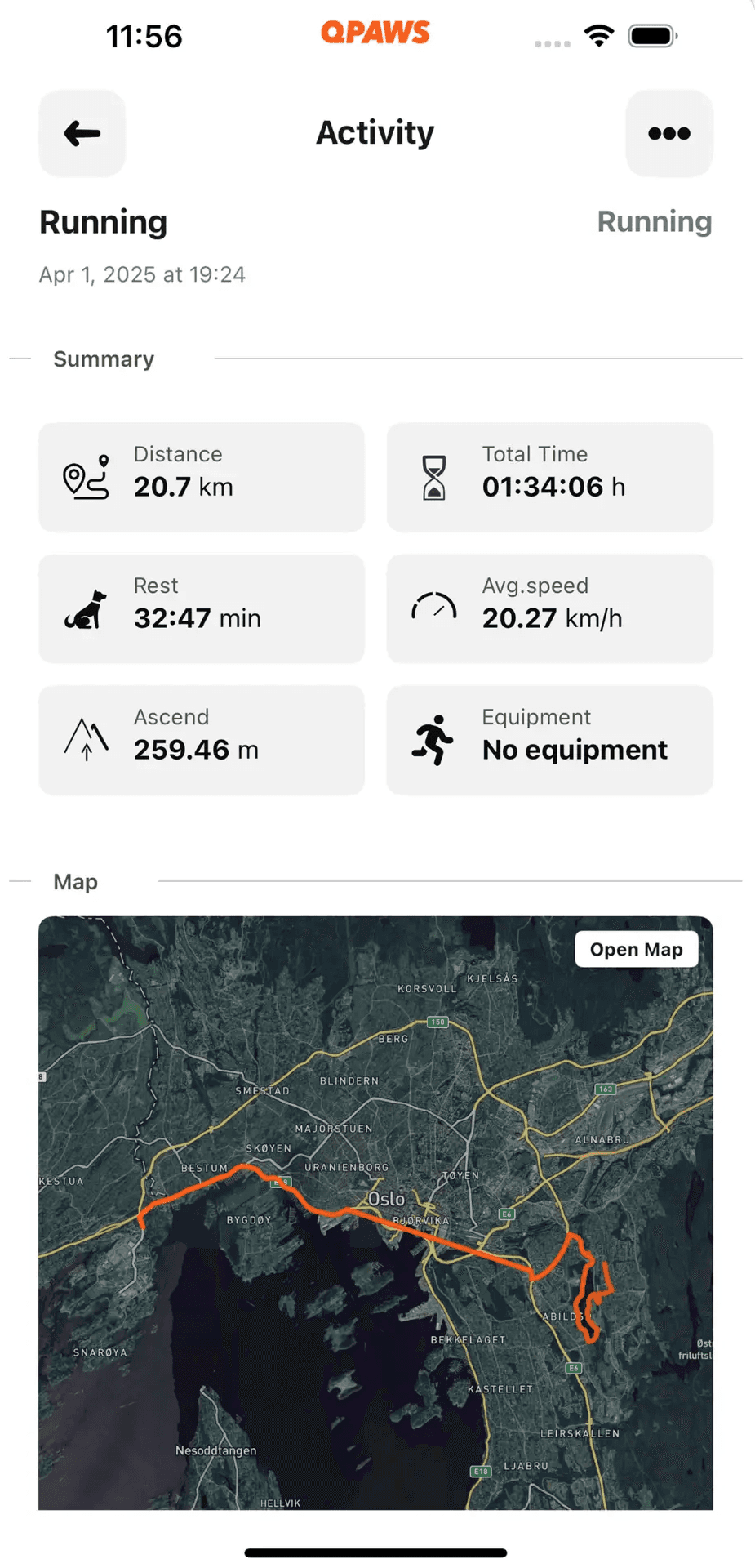
You can log urban sessions in Qpaws to track effort, recovery, and progress over time rather than relying on isolated data points.
Qpaws lets you log every session – effort level, duration, terrain type, and your dog's post-session state – so you can see training patterns and recovery trends across weeks, not just individual sessions. Over a training block, patterns emerge that single-session data never shows.
The Bottom Line
City living is not a disqualifier from competitive canicross. It's a different training environment with different tools – and some genuine advantages over trail-only training.
The athletes who adapt to their environment – who use a hill car park for strength work, a busy street for focus training, and a city park for intervals – develop fitness and skill that trail-only athletes often lack.
Your next race isn't won on the trail. It's won in the weeks of deliberate, consistent work that came before it. That work can happen anywhere.
Training in the city? Log your sessions, track your dog's progress, and find patterns you'd never spot session by session. Start free on Qpaws.
Related articles:

![Dog Endurance Training: Build Stamina Safely [Guide]](https://framerusercontent.com/images/7Y2HphZSTrLGkXRZ9TrZXx7u30.png?width=2240&height=1260)