





You've seen the photo or the video: someone on a mountain bike being pulled by a dog (or two dogs) down a trail at speed. It looks fast. It looks like a lot could go wrong.
It can. But when it goes right, bikejoring is one of the most demanding and rewarding disciplines in dog-powered sports. This guide explains what the sport actually is, what you need to start, and how to approach it safely from session one.
What Bikejoring Actually Is
Bikejoring is cycling with your dog attached to the front of your bike via a bungee towline. The dog runs ahead and pulls. You pedal to assist on climbs, balance on technical terrain, and brake on descents. Together, you move faster than either of you would alone.
Like canicross, bikejoring developed from mushing – it began as an off-season conditioning method for sled dog teams who needed to maintain fitness when there was no snow. Dryland mushing disciplines eventually became competitive sports in their own right, and bikejoring is now formally governed by the IFSS (International Federation of Sleddog Sports) alongside canicross, scooter, rig, and skijoring.
Competitive bikejoring runs in 1- and 2-dog categories. The 1-dog class is the natural starting point for most beginners. The 2-dog class involves running a pair of dogs side by side – a different set of technical challenges that belongs after you've mastered the single-dog format.
Who It's For
On the dog's side: The same breeds that excel at canicross do well in bikejoring – Huskies, Malinois, Vizslas, Weimaraners, German Shorthaired Pointers, working-line mixed breeds. Forward drive and the desire to run ahead of a handler are the essential qualities. Speeds in bikejoring are significantly higher than canicross, so the dog needs to be comfortable with sustained effort at pace.
The same age restrictions apply as in all pulling disciplines: growth plates must be fully closed before a dog pulls in harness – typically 12 to 18 months, depending on the breed, with larger breeds needing the full 18. Do not start earlier.
One important note on sequencing: if your dog is new to dog-powered sports, canicross is the better entry point. It builds the harness work, command foundation, and aerobic base that bikejoring relies on – and it does so at a pace and speed that is more forgiving while you and your dog are learning together.
On the rider's side: You need to be a competent, confident cyclist before you add a dog to the front of your bike. Not a racer, but comfortable on trail terrain at speed, capable of riding one-handed when needed, and confident in your braking. If descents on technical trail currently make you nervous, build that skill first. Adding a dog to a situation you're not fully in control of makes it less controllable, not more.
The Gear
The Dog's Side
A pulling harness. Not a walking harness. Not a collar. A purpose-built pulling harness – X-back, H-back, or sport/Y-front style – that distributes force across the dog's chest and shoulders without restricting stride or compressing the trachea. Getting this wrong is still the most common beginner mistake in every dog-powered sport.
A bungee gangline. The line between the dog and the bike. The bungee section absorbs shock when the dog surges forward or you brake suddenly. Without it, the jolt transfers directly to the dog's spine and to your handlebars. Standard bikejoring lines run 2–3 metres in length, with the bungee section in the middle. Shorter for technical terrain, longer on open trail.
The Bike Side
A bikejoring attachment. The gangline needs to connect to your bike at a point that allows the dog to steer freely without the line getting caught in the front wheel. Two mounting positions are common:
Fork mount (springer): A metal spring attachment that clips to the front fork. The spring absorbs lateral pull when the dog moves sideways, so the line doesn't snap the handlebars. This is the standard setup for bikejoring and the right starting point for beginners.
Seat post mount: Less common, changes the pull angle, used by some riders on specific terrain. Not the first choice.
Start with a fork-mounted springer. It's what the sport was built around.
Bike type. A hardtail mountain bike is the standard for bikejoring – trail geometry, wide bars for control, and reliable disc brakes. Full suspension works, but it isn't necessary. Rigid bikes and road bikes are not suited to the terrain or the pull dynamics.
A helmet. Not optional, not a discussion. Bikejoring involves speeds of 25–35 km/h on trail surfaces, with a dog making directional inputs you didn't plan for. Wear a helmet every session, from the first.
The One Command You Cannot Skip
Every dog sport has commands. Bikejoring has one that is non-negotiable before you leave the trailhead: "whoa".
In canicross, if your dog doesn't stop on command, you slow down and stop. On a bike on a descent, that option isn't available in the same way. A dog that pulls hard into a sharp corner without responding to a stop command is a serious safety problem: for the dog, for you, and for anyone else on the trail.
Train "whoa" to a reliable standard: full stop, feet still, sustained – before you attach the towline to a moving bike. That's the threshold. Not "mostly stops" or "stops if I stop pedaling." Reliable.
Your other working commands for bikejoring:
hike (or "let's go"): move forward,
easy: slow the pace,
whoa: full stop,
gee / haw: right and left, if using directional commands,
on by: pass a distraction without engaging.
If your dog already has this foundation from canicross work, it transfers directly. If they're starting from scratch, build the commands on foot before you attach any towline to any vehicle.
The First Sessions
Before You Ride: Introduce the Setup on Foot
Don't get on your bike in session one. Walk your dog in a harness with the gangline connected to the bike springer, pushing the bike behind you, and let the dog get used to the feel of pulling something forward. Familiar surface, familiar route, low stakes.
This step is worth taking seriously. A dog that understands the towline and the bike before you're moving fast is a dog that will work with you on the trail. A dog that encountered both for the first time at speed is a dog that will be managed reactively for weeks.
Sessions 1-3: Low Speed, Known Ground
Short routes (3-5 km), low speed, terrain you know well. No technical sections, no tight corners, no descents that require hard braking. The goal isn't distance or pace, but the dog understanding the format: run forward, respond to commands, tolerate the bike close behind.
Check paw condition after every session. Bikejoring surfaces are often harder and faster than typical walking terrain. Gravel and dry trail at 25 km/h affects paw pads differently than the same surface at a walk. Warm weather compounds this significantly – hot, dry trail can wear pads quickly at speed.
Sessions 4–8: Building Distance and Terrain
Extend to 8–12 km. Introduce gentle hills – climbs are good conditioning work, and descents are where your braking and your dog's stop commands get tested in real conditions for the first time. Watch for the patterns: does your dog pull harder after a short rest? Do they fade in the final third? Does technical terrain change their drive?
Those observations are worth more than your pace data. They're also the data that turns into training intelligence – but only if you're keeping a consistent record of them.
The Competitive Scene
Bikejoring races run as part of dryland mushing event calendars — the same events that include canicross, scooter, and rig categories. Race distances at the entry level typically sit between 5 and 12 km on marked trail courses.
The atmosphere is consistent with what you'd find in canicross: knowledgeable, welcoming, with a wide spread of experience levels at the entry end. Most events attract seasoned mushers alongside people running their first race on borrowed kit.
Finding events: start with your national federation. IFSS member federations run sanctioned dryland races across most European markets, with the season concentrated in the autumn and winter months. Local clubs often run informal training races and time trials that are a better first environment than a formal competition.
What to Log from Session One
The data that matters in bikejoring is split between you and your dog – and most of it belongs to the dog.
After every session, record: which dog ran, distance, terrain type, drive through the session (strong throughout / faded / reluctant to start), paw condition check, and how the dog moved and behaved in the hours afterwards.
The post-session observation is the one most often skipped and most consistently predictive. A dog that's flat and disengaged the evening after a session hasn't fully recovered from it. Logged across weeks, that signal becomes an early-warning system – one that shows up in your records before it shows up as a performance problem or an injury.
Your GPS track and heart rate belong in whatever platform you prefer. Your dog's data belongs somewhere that has fields for it. Standard fitness apps have no bikejoring activity type and no field for your dog – logging it as cycling loses half of the session that matters most.
Start the Record on Day One
The handlers who progress fastest in bikejoring are not the ones with the fastest dogs. They're the ones who know their dogs well enough to spot a training problem forming before it becomes an injury.
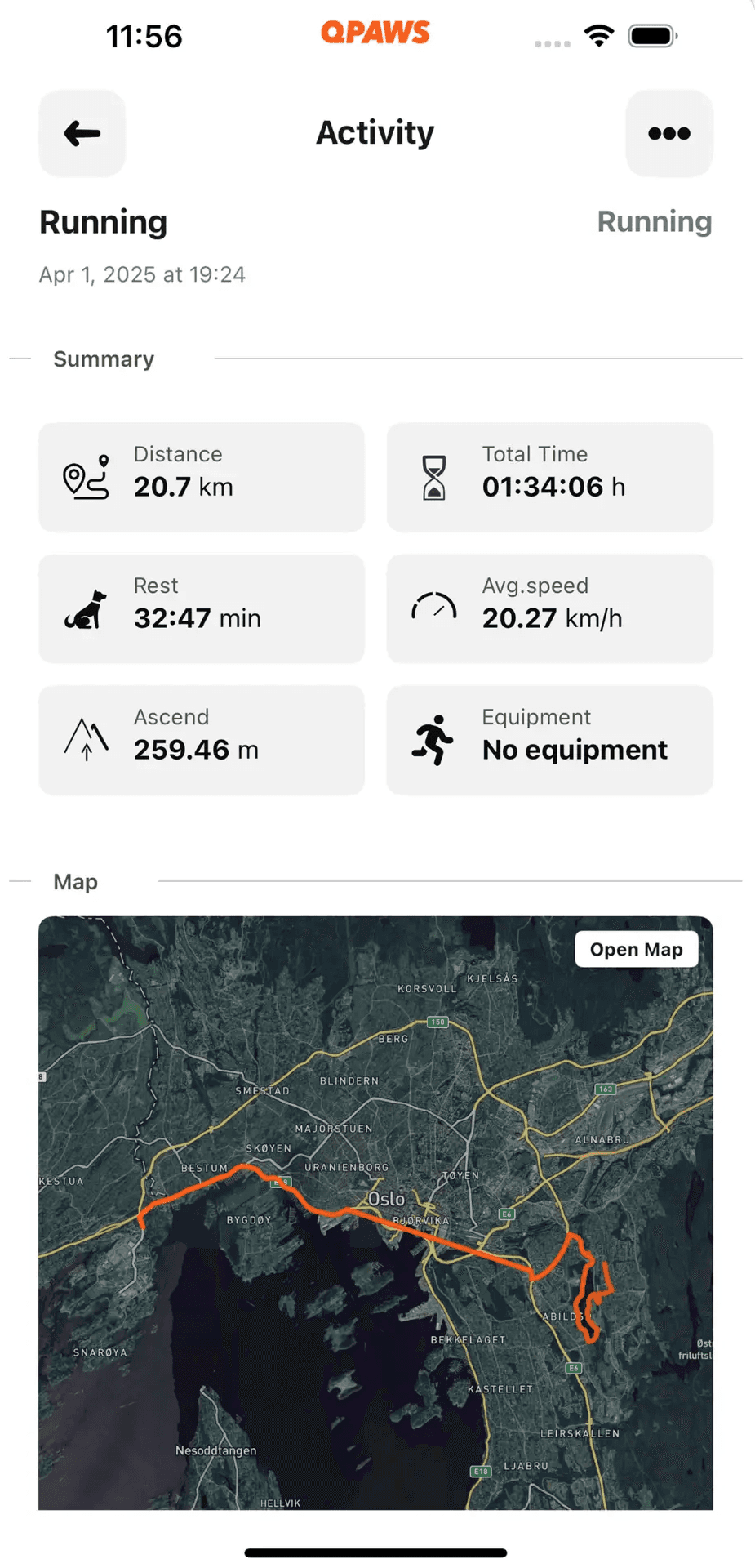
That knowledge is built session by session. Start tracking from your first ride in Qpaws – bikejoring sessions logged as bikejoring, per-dog data, paw condition, drive observations, and recovery notes. The record you start in week one is what makes the decision in month six readable.
Related articles:

![Dog Endurance Training: Build Stamina Safely [Guide]](https://framerusercontent.com/images/7Y2HphZSTrLGkXRZ9TrZXx7u30.png?width=2240&height=1260)