




You watch your dog's stride every time you head out together. The rhythmic patter of paws on trail, the stretch of their body at full speed, the way they shift weight through a turn. But how often do you really look?
A dog's gait tells a story. It reveals fitness, fatigue, pain, and potential problems – long before a limp shows up. Whether you're training for canicross season or simply keeping your dog active on daily runs, learning to read your dog's movement is one of the most practical skills you can develop.
What Is Gait Analysis (and Why Should You Care)?
Gait analysis is the study of how an animal moves – the pattern, rhythm, and mechanics of their stride. In
veterinary medicine, it's used to diagnose orthopedic injuries, neurological issues, and joint disease. But you don't need a vet degree to start paying attention.
For active dogs, gait changes are often the earliest warning sign that something is off. A shortened stride, a slight head bob, a reluctance to push off one leg – these are signals that show up during activity, sometimes weeks before your dog starts limping at home.
Catching these changes early means the difference between a few rest days and a months-long recovery.
The Four Basic Dog Gaits
Dogs move in four primary gaits, each with distinct patterns:
Walk – the slowest gait. Three paws are on the ground at any time. This is where asymmetry is easiest to spot because the pace is slow enough to observe each leg individually.
Trot – diagonal legs move together (left front with right rear, and vice versa). This is the most efficient gait for sustained movement and the one you'll see most during jogs and canicross runs. It's also the best gait for spotting irregularities, because the diagonal pairing makes any imbalance obvious.
Canter/lope – an asymmetrical, three-beat gait. One side leads. Dogs naturally favor a leading side, but if your dog suddenly switches or refuses to lead with a specific leg, take note.
Gallop – full speed. All four paws leave the ground briefly. Hard to analyze in real time, but useful to observe if your dog seems hesitant to open up or shortens their suspension phase.
What to Watch For: Common Gait Red Flags
You don't need slow-motion video (though it helps). Start by watching your dog from the side, from behind, and from the front during a trot. Here's what abnormal movement looks like:
Head bobbing – when a dog drops their head as a front leg hits the ground, they're shifting weight away from a painful limb. The head drops on the sound leg, rises on the sore one.
Hip hiking – similar principle for the rear. If one hip rises higher than the other during movement, the dog is unloading the opposite hind leg.
Shortened stride on one side – the dog takes a visibly shorter step with one leg compared to the other. Often subtle. Comparing left and right is key.
Stiffness after rest – your dog moves stiffly for the first few minutes of a run, then "warms out of it." This is common with joint inflammation or early arthritis and shouldn't be dismissed just because it resolves.
Pace changes without terrain reasons – slowing down on flat ground, reluctance to maintain a trot, or breaking into a walk unprompted during a route your dog normally handles.
Bunny hopping – both hind legs move together instead of alternating. In puppies, this can indicate hip dysplasia. In adult dogs, it often signals hip or lower back pain.
How to Observe Your Dog's Running Form
Make it a habit, not a one-time thing. The real value of gait observation comes from knowing what normal looks like for your dog so you can spot when something changes.
Film short clips regularly. Even 10 seconds of video from the side during a trot gives you a baseline. Do this once a week during training. When something feels "off" later, you'll have footage to compare.
Watch from multiple angles. Side view shows stride length and head carriage. The rear view shows hip symmetry and tracking. The front view shows shoulder loading and paw placement.
Observe on hard, flat surfaces. Grass and trails mask subtle irregularities. A paved path or hard-packed dirt gives you the clearest picture.
Check at the start and end of a run. Fatigue-related gait changes at the end of a session tell you about fitness limits and potential overtraining. Changes at the start suggest stiffness or lingering soreness.
Where Activity Tracking Fits In
Gait changes don't always show up as a visible limp. Sometimes the first sign is behavioral: a dog that gradually covers less distance at the same pace, takes more breaks, or shows declining performance across sessions.
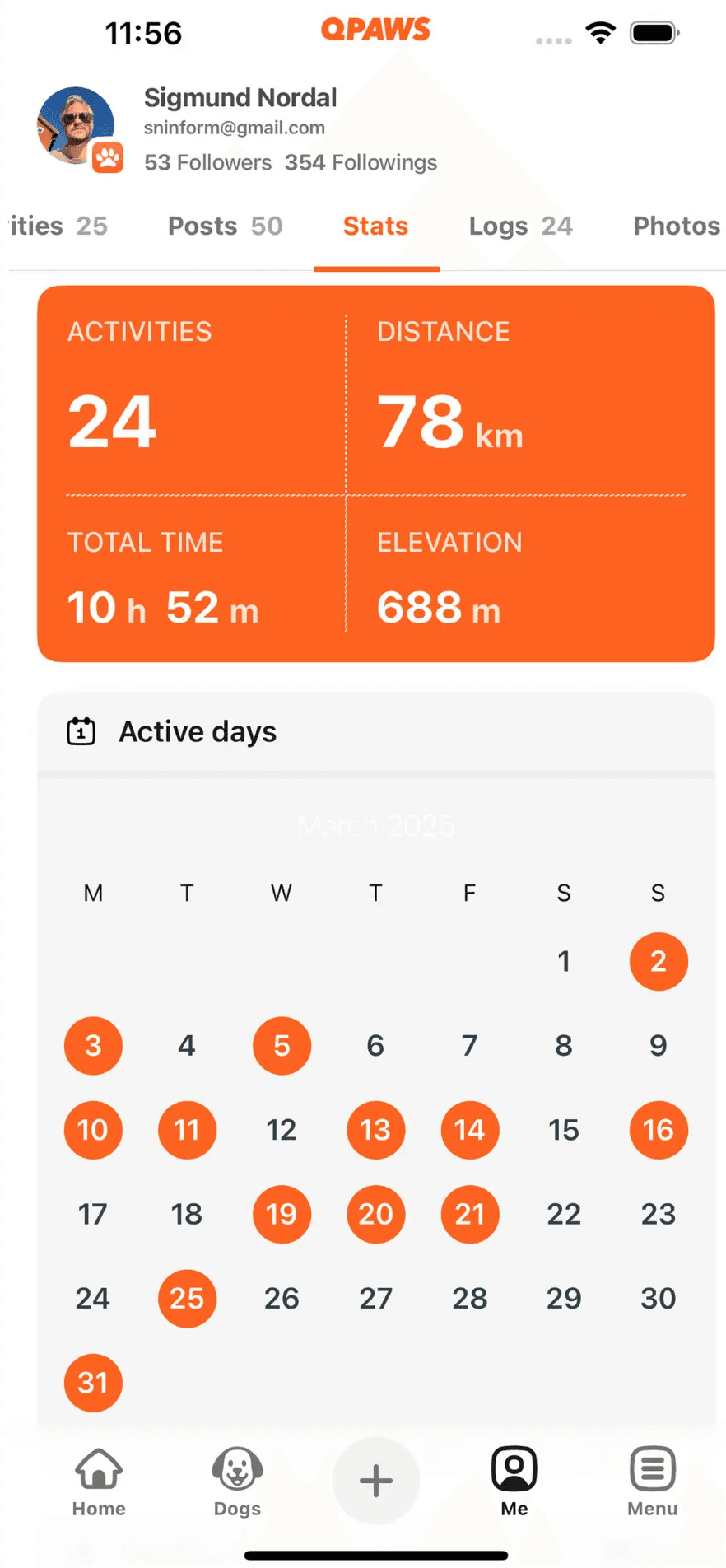
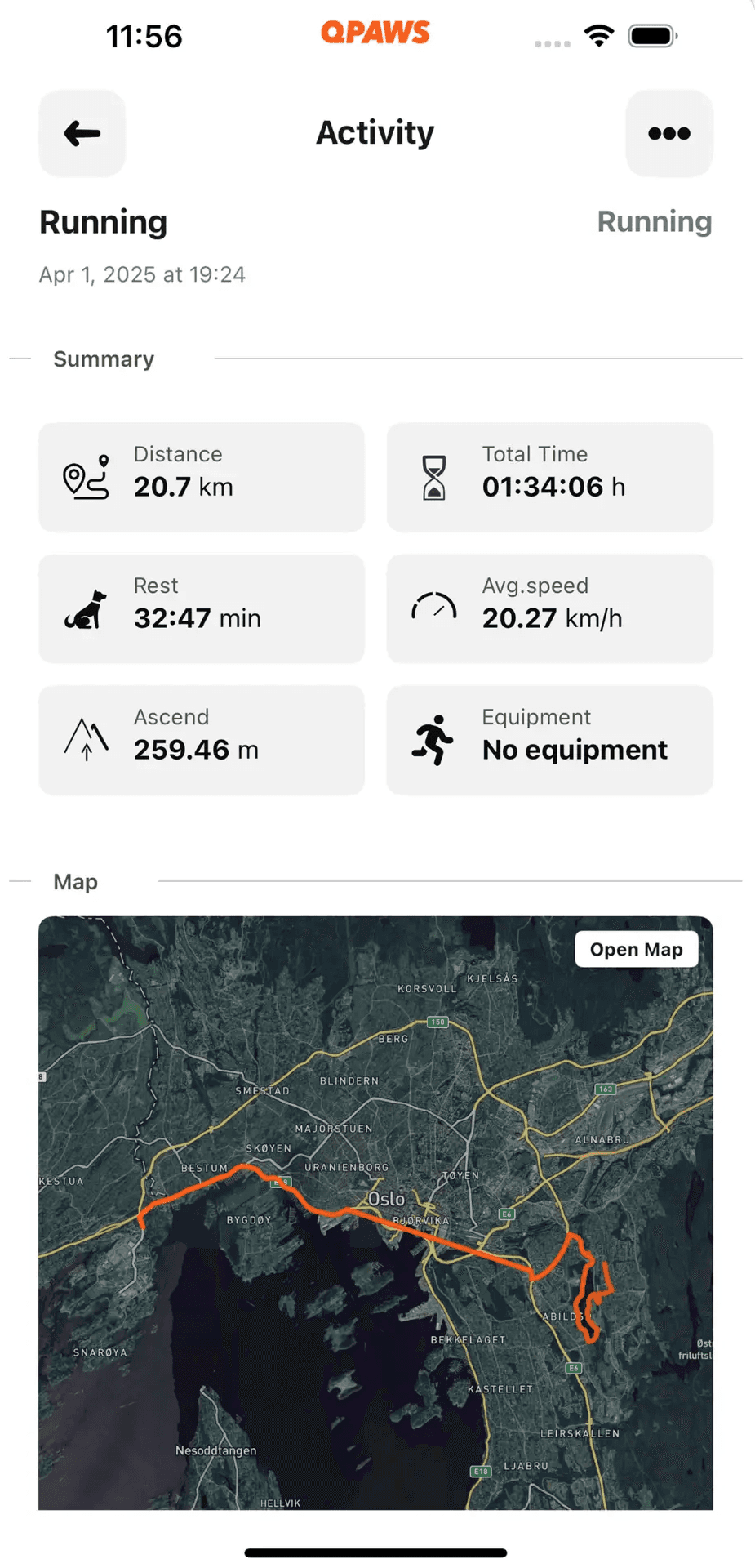
This is where consistent data makes a difference. If you're logging your dog's activity – distance, duration, pace, rest patterns – you build a picture over weeks and months that your eyes alone can't capture.
A 10% drop in average pace over two weeks might be invisible on any single run. Tracked over time, it's a clear signal worth investigating.
Track your dog's activity trends in Qpaws to spot performance shifts before they become injuries.
When to See a Vet
Trust your observations. If you notice any of the following, schedule a checkup rather than pushing through:
a gait irregularity that persists across two or more sessions,
reluctance to perform movements your dog previously did without hesitation (jumping, turning, accelerating),
visible muscle asymmetry – one leg or hip looks noticeably different from the other,
any sudden-onset lameness, even if your dog still seems willing to run.
Dogs are remarkably good at masking pain. They'll run through discomfort because they want to be with you. That's exactly why your observations matter more than their enthusiasm.
__________
FAQ
What is the best gait to observe for signs of injury in dogs?
The trot is the most useful gait for spotting irregularities. Because diagonal legs move in pairs, any asymmetry or lameness becomes more visible than at a walk or gallop.
Can I do gait analysis at home without special equipment?
Yes. All you need is a flat, firm surface and your phone camera. Film your dog trotting from the side, front, and rear. Compare clips over time to spot changes.
How often should I check my dog's running form?
For active and sporting dogs, a brief visual check every session and a recorded clip once a week is a good habit. For dogs on a lighter exercise schedule, once or twice a month is sufficient.
What's the difference between a gait problem and normal variation?
All dogs have slight natural asymmetries. A gait problem is a change from your dog's normal pattern – which is why establishing a baseline matters. If something looks different from how your dog usually moves, pay attention.
My dog warms up out of stiffness quickly – is that still a concern?
It can be. Stiffness that resolves with movement is a classic sign of joint inflammation or early degenerative changes. It's worth mentioning to your vet, especially in older or heavily trained dogs.
Related articles:

![Dog Endurance Training: Build Stamina Safely [Guide]](https://framerusercontent.com/images/7Y2HphZSTrLGkXRZ9TrZXx7u30.png?width=2240&height=1260)