

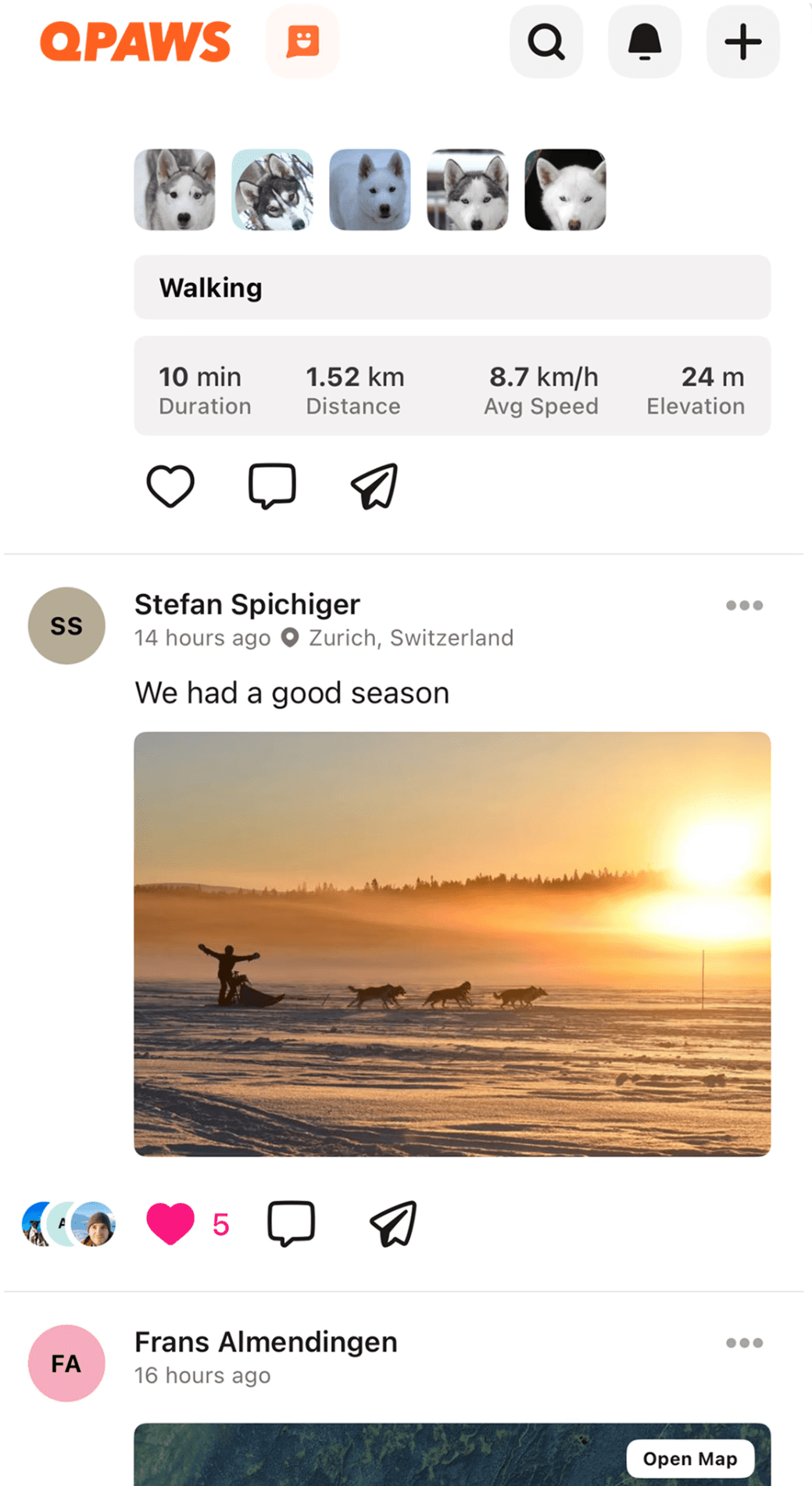
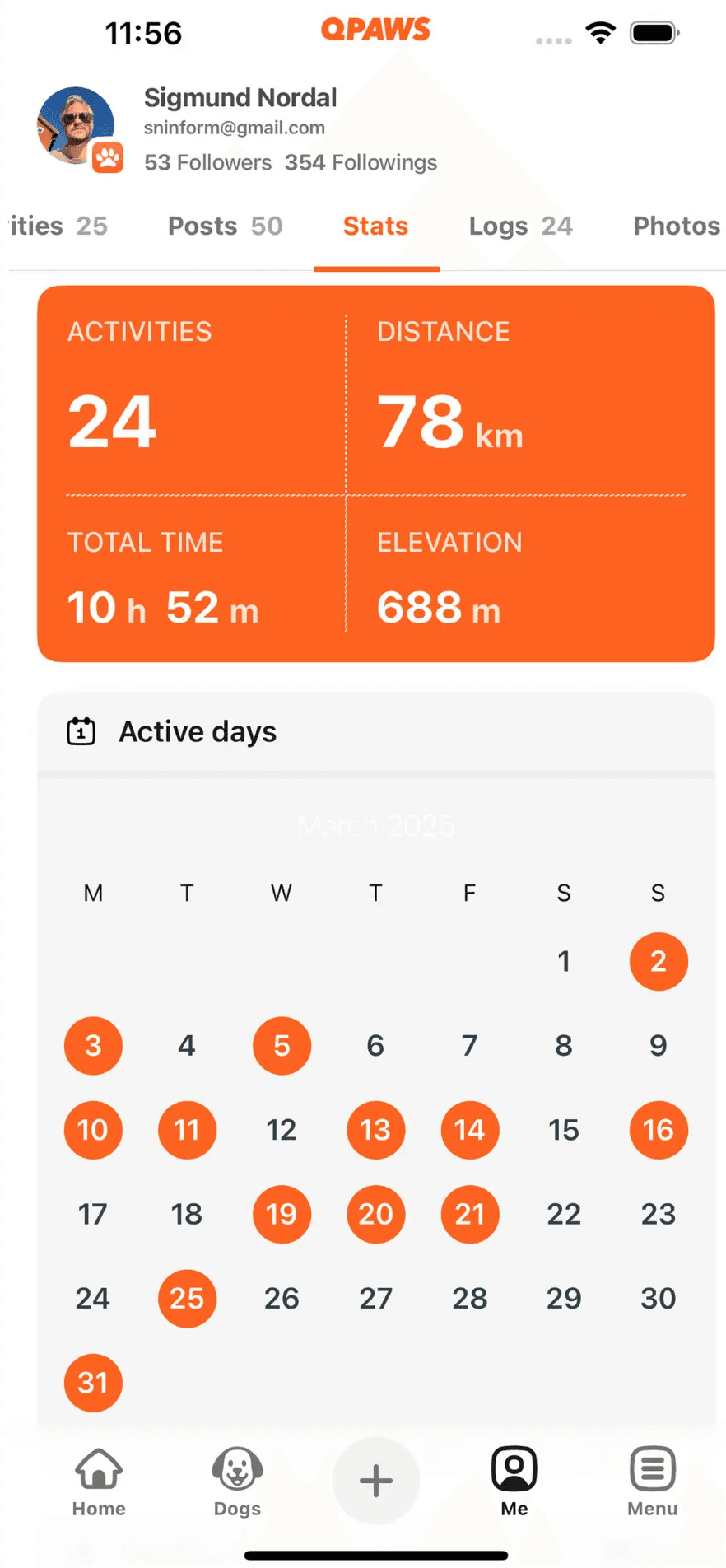
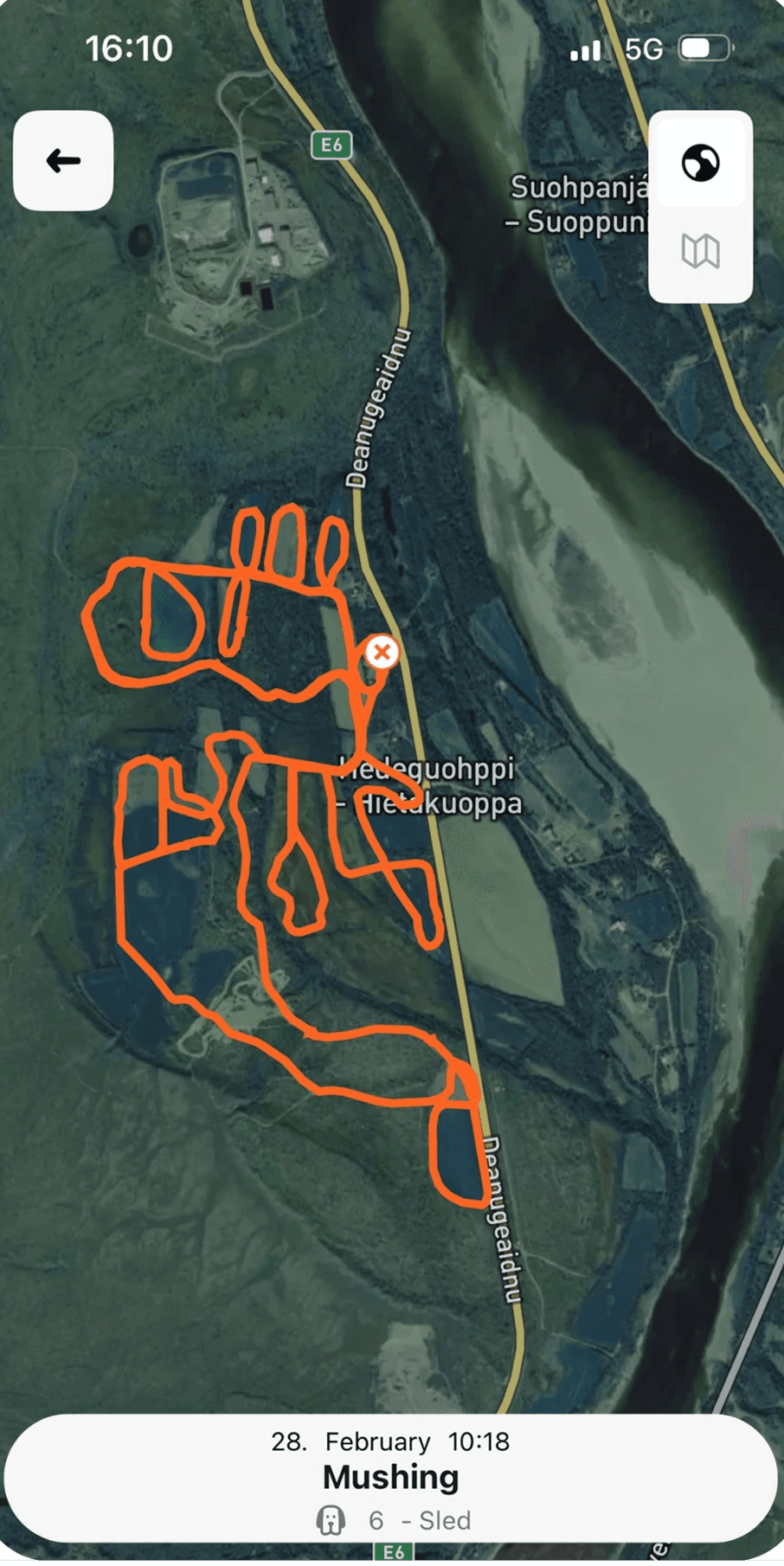




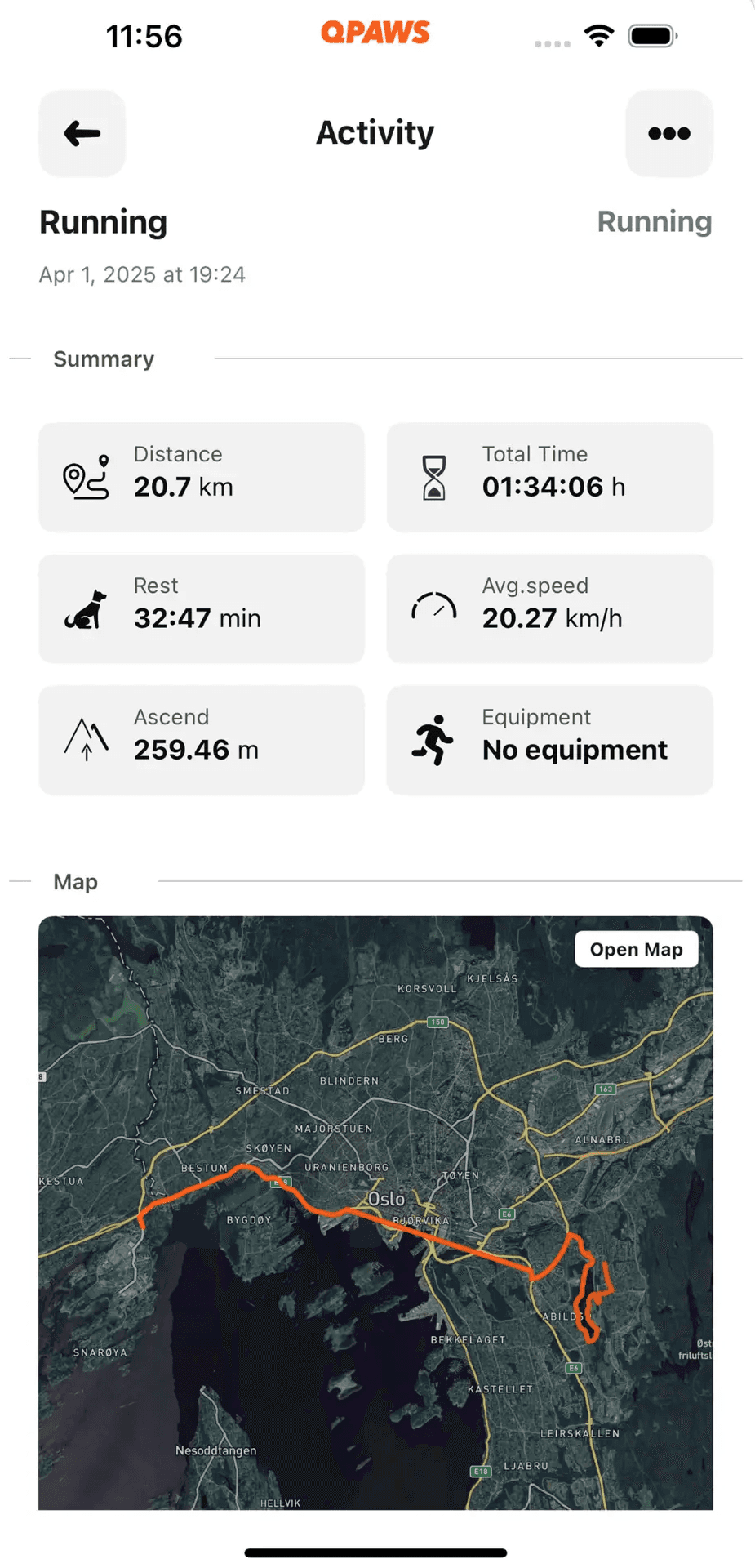
If you log your skijoring sessions in a fitness app, you've already made a compromise. You've picked "cross-country skiing" or "other workout" and accepted that the data going in doesn't reflect what actually happened. Your speed looks roughly right. Your heart rate looks roughly right. Your dog is invisible.
This is the standard skijoring tracking problem. Every platform with a workout library – Garmin, Strava, Apple Health – has cross-country skiing. None of them has skijoring. So you log it as something it isn't, and half the session disappears.
This article covers what skijoring involves, what you need to start, and what you should actually be tracking – so the record you build means something across a full season.
What Skijoring Actually Is
Skijoring is cross-country skiing with a dog pulling you forward. The dog runs ahead on a towline attached to a waist belt worn by the skier. The dog provides forward momentum; the skier adds power on climbs, brakes on descents, and manages direction. Together, you move faster than either of you would alone, and across terrain that rewards endurance from both ends of the line.
Like canicross and bikejoring, skijoring developed from the mushing world as an off-season conditioning method that became a competitive discipline in its own right. It's governed by the IFSS alongside dryland sports – bikejoring, scooter, rig – which means the race structure, timing formats, and command language are shared across all the pulling disciplines.
Competitive skijoring runs in 1- and 2-dog categories over courses that typically range from 5 to 20 km, depending on race level and class. The dynamics change significantly between formats: a single dog provides consistent forward assist at measured speeds; a 2-dog team at race pace on groomed trail is a different level of technical demand entirely.
The sport is most active in northern Europe, Scandinavia, Canada, and the northern US, where groomed trail access is reliable through winter. But skijoring doesn't require groomed trails – many handlers train on packed snowmobile routes, forest paths, and prepared cross-country loops throughout the season.
Who It's For
On the dog's side: the same profile that works in canicross and bikejoring: forward pull drive, comfort running in harness, willingness to run ahead of a moving handler. Breeds with working mushing backgrounds (Huskies, Malamutes, Nordic mixed breeds) are the natural fit. Medium-to-large dogs with endurance-built genetics also perform well: Weimaraners, German Shorthaired Pointers, working-line Malinois, and versatile hunting breeds.
One consideration that matters more in skijoring than in summer disciplines: cold-weather tolerance. Dogs with thin coats and low cold tolerance can struggle in sustained low temperatures, particularly once the temperature drops. This doesn't make them incompatible with the sport, but it changes session planning – shorter durations, attention to wind chill, and post-session warmth management all need to be accounted for.
The same growth plate rule applies as in every pulling sport: don't put a dog in a pulling harness until growth plates are fully closed – typically 12 to 18 months, depending on breed size, with larger breeds needing the full 18. This threshold doesn't move based on how keen the dog looks in a harness.
On the skier's side: you need to be a competent cross-country skier before you add a dog. Not a racer, but comfortable on varied trail terrain at moderate speeds, able to ski one-handed when needed, and confident in your braking on a descent. Adding a dog providing 10–20 kg of forward assist to a skier who's still working out their technique compounds the variables at the worst possible moments.
If you're new to both skiing and dog-powered sports, canicross is the right starting point. It builds the command foundation and harness work that skijoring depends on, at a pace where the consequences of learning are lower.
The Gear
The Dog's Side
A pulling harness. Not a walking harness, not a collar. A purpose-built X-back or H-back harness that distributes force across the chest and shoulders without restricting stride or compressing the trachea. Fit matters: a harness that rides too high restricts shoulder movement at extended trot; one that's too long creates skin contact issues in the girth area. Every dog needs their own properly fitted harness, not a borrowed kit in approximately the right size.
A bungee towline. 2.5–3 metres is standard, with a bungee section to absorb shock when the dog surges or the skier brakes suddenly. Without it, that energy transfers directly to the dog's harness attachment and to the skier's waist belt at the same moment. The line needs to run between the skis, not clipped to a side-mounted point. Correct line geometry keeps the tow angle straight behind the dog and prevents the line from catching on ski tips or binding hardware.
The Skier's Side
A skijoring belt. A padded waist belt – wider and more structured than a canicross belt – that distributes pull force across the hips and lower back. The towline attaches to a front or side ring. The belt must sit low on the hips, not around the waist, and must include a quick-release mechanism. If the dog goes in an unexpected direction on a descent, a quick-release is how you exit the situation before it gets worse. This is not an optional feature.
Classic cross-country skis and poles. Skate skis can work on groomed trails but are harder to control at variable speeds. Classic-style touring skis on most terrain are more forgiving, particularly off-trail and when a dog is providing unpredictable lateral pull. Metal edges help on icy descents and packed routes.
Cold-weather layering with freedom of movement. You're working harder than a solo skier – the dog assists, but you're still skiing actively. Base layer, mid layer, and wind shell rather than heavy insulation. Gloves need to allow quick-release operation without fumbling.
Commands
The command set is shared across all pulling disciplines. If your dog already has canicross or bikejoring training, these transfer directly:
Hike (or "let's go"): move forward
Easy: slow the pace
Whoa: full stop
Gee / haw: right and left
On by: pass a distraction without engaging
The stop command is non-negotiable for the same reason it is in bikejoring: on a descent, your ability to stop independently is more limited than it would be on flat ground. A dog that stops "mostly reliably" in training will not stop reliably on a descent with a distraction ahead. Train it to a consistent standard: full stop, feet still, sustained, before you're on terrain where the gradient removes your margin.
Training Progression
Start on flat, familiar terrain in short sessions (3–5 km) while the dog adjusts to pulling on skis rather than alongside a runner or behind a bike. The visual and sound profile of skis is different from what the dog encountered in canicross or bikejoring, and most dogs need a few sessions to understand what's moving behind them.
Introduce hills gradually. Climbs are good conditioning work and low-risk – the skier provides extra drive, the dog maintains pull. Descents are where the dynamics shift: the dog may pull less or stop pulling altogether, and speed management transfers to the skier. Practice the stop command on gentle descents before you're on terrain that requires it in earnest.
Paw care in cold conditions is more active than in summer sports. Ice balls form between toes in wet snow; certain snow conditions wear pads faster than others; ice and salt on groomed routes affect paws differently than soft powder. Check paws after every session and establish a pre-session boot or protective wax routine if conditions require it.
What You Should Actually Be Tracking
Here is what gets lost when you log a skijoring session as cross-country skiing.
Your GPS tracks where you went. Your heart rate records your effort. Nothing records which dog ran, how the dog performed through the session, whether the drive was strong or flat in the final third, whether there was any gait asymmetry on the left downhill turn, or whether paw condition after session two was worse than after session one.
That's the data that matters in skijoring. Not your skiing pace – the dog's half of the session.
After every outing, record: which dog ran, distance, terrain type, drive level through the session (strong throughout / faded / reluctant to start), any gait observations under load, paw condition post-session, and how the dog moved and behaved in the hours afterward.
The post-session window is the one most often skipped and most consistently predictive. A dog that's flat and disengaged the evening after a session hasn't fully recovered from it. Logged consistently across a four-week block, that signal becomes an early warning – visible in your records before it becomes a performance problem or an injury.
Your GPS track and your personal heart rate data belong in whatever platform you prefer. Your dog's session data belongs in a system that has fields for it. No mainstream fitness app has a skijoring activity type and no field for per-dog observations. Logging it as "cross-country skiing" isn't a workaround, but it's a record that means less every month you add to it.
Start the Record at the First Session
The handlers who manage their dogs well across a skijoring season are not the ones with the fastest times. They're the ones who noticed, in week three, that post-session recovery was taking longer than expected – and who had three weeks of logged data to confirm the pattern rather than a vague sense that something felt off.
That pattern is only visible in the record. Start tracking from session one in Qpaws — skijoring sessions logged as skijoring, per-dog data, drive observations, paw checks, and recovery notes. The record you build in the first week is what decides in week ten readable.
Related articles:

![Dog Endurance Training: Build Stamina Safely [Guide]](https://framerusercontent.com/images/7Y2HphZSTrLGkXRZ9TrZXx7u30.png?width=2240&height=1260)