





It always happens at the wrong moment. You're at the boarding facility, bags in the car, trip imminent – and the person behind the counter is asking for proof of Bordetella vaccination. The certificate is at home. Or in the glovebox. Or in a folder you haven't opened since last spring.
For active dog owners managing training schedules, competition calendars, and multi-dog households, vaccine records are one of those administrative problems that feel manageable until they're not. The fix isn't more organisational discipline. It's a system built to work at the moment of need – not just at home, at your desk, with time on your hands.
Here is what that system looks like.
What Records You Actually Need on Hand
Not every document your vet has ever generated matters equally. The ones worth having instantly accessible are the ones that get asked for.
Core vaccine records:
Rabies – Required by law in most regions. Asked for at virtually every boarding facility, many dog parks, and all international border crossings.
DHPP – The core multi-valent vaccine covering distemper, hepatitis, parvovirus, and parainfluenza. Usually combined into one record.
Kennel cough / Bordetella – Required by nearly every boarding facility. Increasingly requested at dog parks and multi-dog events.
Leptospirosis – Required for dogs in areas with wildlife exposure or standing water, and increasingly standard for working and sporting dogs.
Beyond vaccines:
Parasite prevention records – flea, tick, and heartworm. Some facilities and competitions require proof of current prevention, not just vaccination.
Vet visit notes from the past 12–24 months, particularly anything documenting a chronic condition, past injury, or ongoing medication.
Specialist referrals and diagnostics – if your dog has had imaging, a cardiac evaluation, or an orthopedic assessment, keep the summary report. A new vet working blind is a worse situation than a new vet with the history in hand.
For sporting and working dogs – mushers, canicross runners, hunters, agility competitors – add any pre-season health clearances. A vet sign-off before a race season is worth documenting and keeping alongside the rest.
When You Actually Need These Records
There are a handful of moments when vaccine records shift from background admin to front-of-mind urgency.
Boarding and daycare
Most facilities require current proof of rabies, DHPP, and Bordetella before accepting a dog. Some ask for records in advance of drop-off. If you cannot produce them on the spot, you do not board.Dog parks
Vaccination requirements vary by park and region, but the trend is toward formal documentation. Enforcement is patchy; the requirement is not.Competitions and organised sport events
Canicross races, agility trials, bikejoring events, and hunting field days increasingly request health documentation at entry. For multi-day events with kenneling, it is usually mandatory.Travel
Domestic travel with dogs across certain routes (ferries, some airlines, inter-regional movement) may require health certificates. International travel almost always does, with specific vaccine timelines required in advance.Emergency vet visits away from home
This is the one most people underestimate. If your dog is injured at a trail or competition venue and you're at an unfamiliar clinic, having their complete health history on your phone – vaccines, medications, previous conditions – is the difference between a vet making informed decisions and working from scratch.
Why Paper Fails (and Why a Google Drive Folder Isn't Much Better)
The paper envelope in the filing cabinet works fine when you never need it urgently. The moment you need it quickly, somewhere you're not, it fails.
The problems are predictable: paper degrades, gets wet, and gets lost. One copy means one point of failure. If it's at home and you're forty minutes away at a boarding check-in, it might as well not exist.
A photo on your phone is slightly better – until that photo is buried in a camera roll with thousands of images, taken three years ago, at an angle that makes the text barely legible.
A folder in Google Drive is a genuine step up, but it carries its own friction:
You need to be logged into the right account
Sharing means either giving someone access to your account or creating a share link on the spot under pressure
With multiple dogs, a flat file structure becomes disorganised fast – which subfolder is which dog, which filename is the current year's rabies certificate versus the expired one
What makes a system actually work at the moment of need is per-dog separation, accessibility without login overhead, and the ability to share instantly – ideally as a screenshot or PDF the recipient can view without installing anything.
What a Functional Digital Record System Looks Like
A record system that holds up when you need it has a few non-negotiable properties.
Per-dog separation.
If you have two dogs, their records need to be completely separate and clearly labelled. Sending the wrong dog's Bordetella certificate in a hurry is exactly the kind of error a flat shared folder produces.Clear file naming.
rabies_cert.jpgis not a filename.Max_Rabies_2025-09_exp2028.pdfis. The dog's name, the vaccine type, the date issued, and the expiry date, where applicable – all in the filename, so you can identify the document without opening it.Accessible offline or with minimal friction.
A system that requires a clean login flow or a reliable internet connection is a system that fails in a car park.Shareable without requiring the recipient to install anything.
A boarding facility or competition official will not download an app to receive your dog's paperwork. Screenshot or PDF is the format that works universally.Low enough friction to keep current.
The record is only useful if it stays up to date. If updating it after a vet visit takes more than a few minutes, it won't happen consistently.
The Multi-Dog Problem
Managing vaccine records for one dog is straightforward. Managing records for two, three, or four dogs in an active household is a genuine administrative challenge – and one where errors happen most often.
The specific risks: sending the wrong dog's records under pressure, missing a renewal because you thought the other dog was due and tracked it wrong, or having no clear view of which dog is overdue for what across the household.
If you're managing a working team – sled dogs, hunting dogs, multiple canicross athletes – knowing which dog has had what, and when each is next due, needs to be per-dog and visible without digging. Vaccine tracking is part of the same multi-dog management challenge covered in training dogs with different fitness levels – the administrative complexity scales with the number of dogs, and the solution is always per-dog records, not shared ones.
Your Records and Your Vet's Records
Your vet maintains their own records, which cover most routine scenarios. But there are gaps worth knowing about.
If you change clinics, those records do not automatically transfer. If you move. If you're at an emergency clinic that isn't your regular practice. If there's a data issue on their end. Your own copy exists outside all of those failure modes.
Beyond coverage, your own records make annual consultations more productive. A vet who can see what you've been tracking – health signals, appetite changes, anything logged alongside training data – can draw connections that a 15-minute visit alone wouldn't surface. The overlap between daily health data tracking and vaccine and vet visit records provides the clearest picture of your dog's health. Keeping them in the same place makes that picture visible.
Good records are also how early problem detection becomes possible – not because records diagnose anything, but because they give you and your vet a timeline instead of a single data point.
The Practical Setup
If you're starting from scratch:
Gather all current vaccination certificates – physical or existing digital copies
Photograph or scan each one clearly, in good light, with readable text
Label each file with the dog name, vaccine type, date issued, and expiry
Store per-dog, not in a combined folder
Set a calendar reminder 30 days before each expiry date
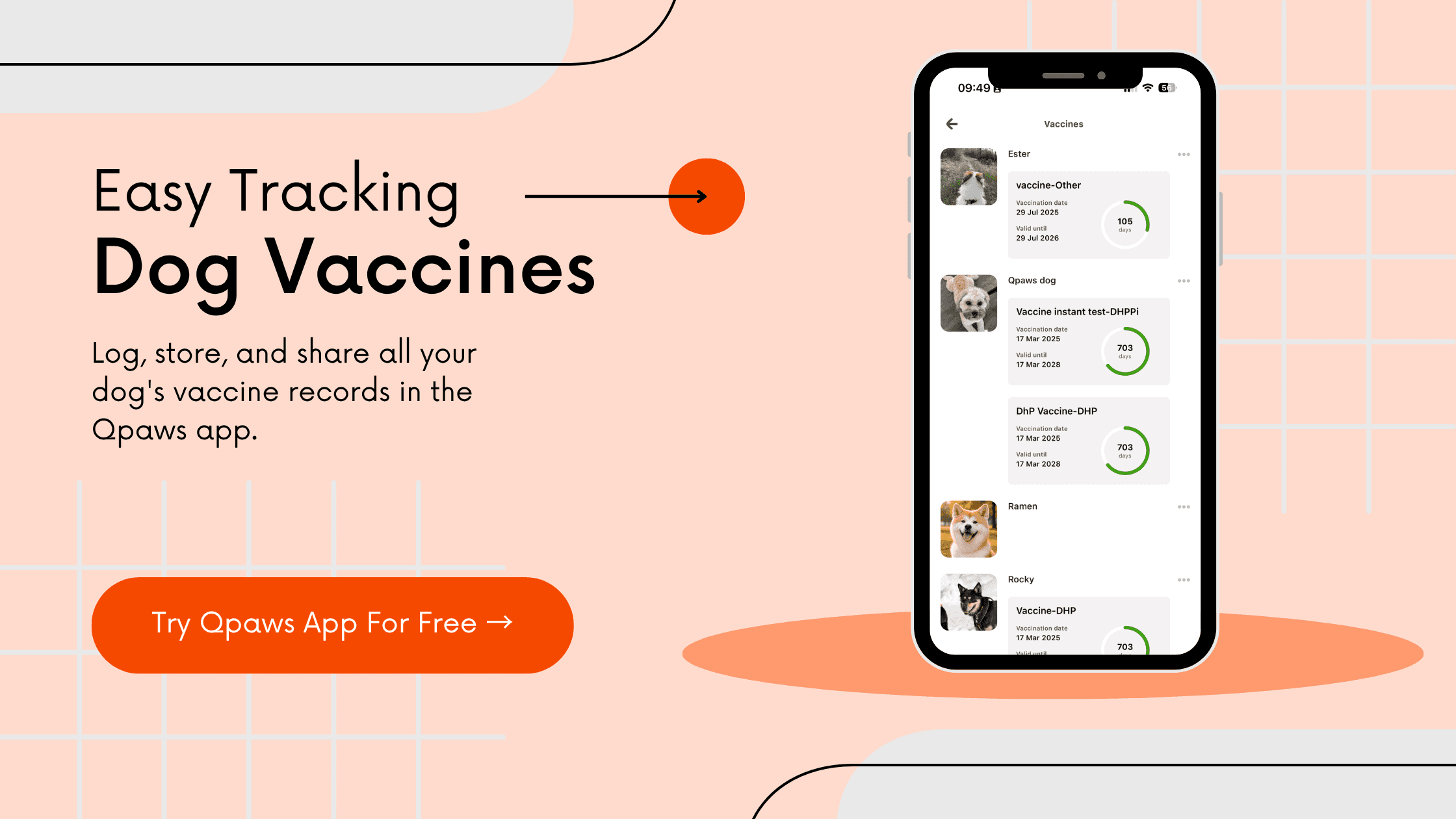
If you're managing multiple dogs or want health records alongside training data in one place, Qpaws keeps per-dog vaccine records, vet visit notes, and full health history on the same profile as training logs. Everything for one dog, in one place, accessible from your phone.
Active dog owners can set up per-dog health and vaccine records in Qpaws.
If you're running a working team – mushers, sled dog handlers, multi-dog sporting households – the hard-core dog musher profile covers what Qpaws tracks across multi-dog training loads and health management.
The paperwork scramble at boarding drop-off is avoidable. The setup takes an hour, once – and almost nothing to maintain after that. Get the records in order before the next moment you need them. That moment will not come with advance notice.
Related articles:


![Dog Endurance Training: Build Stamina Safely [Guide]](https://framerusercontent.com/images/7Y2HphZSTrLGkXRZ9TrZXx7u30.png?width=2240&height=1260)